
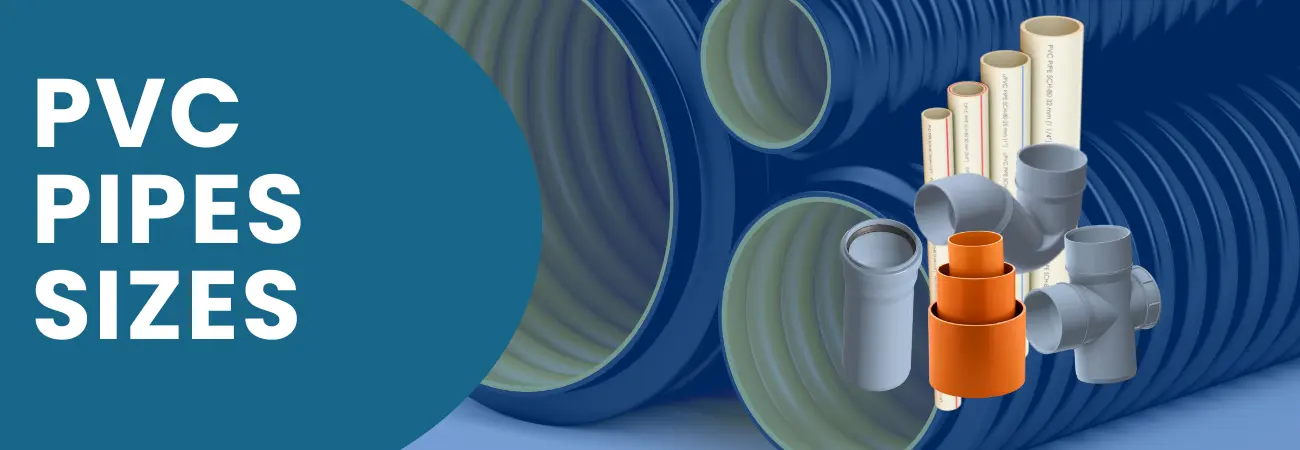
PVC Pipe Sizes
Introduction
What is PVC Pipe :
PVC or Polyvinyl Chloride pipes are used for manufacturing water mains and sewage pipes. Moreover, they are used for irrigation as well. In fact, PVC pipes have successfully replaced the metal piping and are durable, light weight, easy to install, flexible and are recyclable. Overall, this makes them the most cost-efficient and sustainable plastic water pipes.
Furthermore, PVC is made of polyvinyl chloride, a thermoplastic material that can be molded into different desired shapes. Also, PVC pipes are non-toxic and are considered safe. Finally, PVC pipes are versatile and are used for water transportation, and drainage solutions.
Applications of PVC Pipes
In fact, PVC Pipes being highly versatile can be used for many different applications in both pressurised and non-pressure conditions. The primary application being:
- Water Supply
- Irrigation
- Drainage
- Chemical Industry
PVC Pipe Sizes
Manufacturers use PVC, or Polyvinyl Chloride, pipes to make water mains and sewage pipes. They also serve irrigation applications. In fact, PVC pipes have successfully replaced metal piping and are durable, lightweight, easy to install, flexible, and recyclable. Therefore, this makes them the most cost-efficient and sustainable plastic water pipes.
Specifically, manufacturers make PVC from polyvinyl chloride, a thermoplastic material they can mold into different desired shapes. Additionally, PVC pipes are non-toxic and safe. Overall, PVC pipes are versatile, serving water transportation and drainage needs.
Applications of PVC Pipes
Indeed, PVC Pipes, being highly versatile, work well for many different applications in both pressurised and non-pressure conditions. The primary applications include:
- Water Supply
- Irrigation
- Drainage
- Chemical Industry
PVC Pipe Sizes & PVC Pipe Diameters
PVC pipe sizes are available in 20mm, 25mm, 32mm, 40mm, 50mm, 63mm, 75mm, 90mm, 110mm, 140mm, 160mm, 200mm, 250mm and 315mm in different pressure classes like 2.5Kg, 4Kg, 6Kg, 10Kg & 15Kg. Additionally, pipes come in either solvent fit types or Rubber ring fit type, in 3 mtr and 6 mtr lengths. Furthermore, nominal PVC pipe diameters determine these figures. So, for actual dimensions, kindly refer to the dimension charts.
Jump to a chart:
Specification overview
IS:4985 chart
SCH 40/80 chart
SWR chart
Foam core chart
PVC Pipe Specification
| Pipe Group | Class / Type | Standard | Sizes Available | Pressure Class | Joint Type |
|---|---|---|---|---|---|
| PVC UV-R Pressure Pipe | N/A | IS:4985 | 20, 25, 32, 40, 50, 63, 75, 90, 110, 140, 160, 200, 225, 250, 315 mm | 2.5kg, 4kg, 6kg, 10kg | N/A |
| SCH pipe | SCH-40 | ASTM D 1785 | ½”, ¾”, 1”, 1-1/4”, 1-1/2”, 2”, 2-1/2”, 3”, 4”, 6” & 8” | N/A | N/A |
| SCH pipe | SCH-80 | ASTM D 1785 | ½”, ¾”, 1”, 1-1/4”, 1-1/2”, 2”, 2-1/2”, 3”, 4”, 6” & 8” | N/A | N/A |
| IS:13592 pipe | Type-A | IS:13592 | 75, 90, 110, 160 mm | N/A | Ring-Fit & Solvent-Fit |
| IS:13592 pipe | Type-B | IS:13592 | 75, 90, 110, 160 mm | N/A | Ring-Fit & Solvent-Fit |
| Foam core pipe | SN-2, SN-4 & SN-8 | IS:16098-Part1 | 110, 160, 200, 250, 315 mm | N/A | Ring-Fit & Solvent-Fit |
PVC Pipe Dimensions & PVC Pipe Size Chart
In addition, PVC pipe size charts with dimensions are accessible on the website of Ajay Pipes.
1. IS:4985 Dimensions Chart
| Nominal Dia. (mm) | Pipe Diameter (Min-Max) | Class 1 (2.5kg) Wall | Class 2 (4kg) Wall | Class 3 (6kg) Wall | Class 5 (10kg) Wall |
|---|---|---|---|---|---|
| 20 | 20.0-20.3 | N/A | N/A | N/A | 1.1-1.5 |
| 25 | 25.0-25.3 | N/A | N/A | N/A | 1.4-1.8 |
| 32 | 32.0-32.3 | N/A | N/A | N/A | 1.8-2.2 |
| 40 | 40.0-40.3 | N/A | N/A | 1.4-1.8 | 2.2-2.7 |
| 50 | 50.0-50.3 | N/A | N/A | 1.7-2.1 | 2.8-3.3 |
| 63 | 63.0-63.3 | N/A | 1.5-1.9 | 2.2-2.7 | 3.5-4.1 |
| 75 | 75.0-75.3 | N/A | 1.8-2.2 | 2.6-3.1 | 4.2-4.9 |
| 90 | 90.0-90.3 | N/A | 2.1-2.6 | 3.1-3.7 | 5.0-5.7 |
| 110 | 110.0-110.4 | 1.6-2.0 | 2.5-3.0 | 3.7-4.3 | 6.1-7.1 |
| 140 | 140.0-140.5 | 2.0-2.4 | 3.2-3.8 | 4.8-5.5 | 7.7-8.9 |
| 160 | 160.0-160.5 | 2.3-2.8 | 3.7-4.3 | 5.4-6.2 | 8.8-10.2 |
| 200 | 200.0-200.6 | 2.9-3.4 | 4.6-5.3 | 6.8-7.9 | 11.0-12.7 |
| 225 | 225.0-225.7 | 3.3-3.9 | 5.2-6.0 | 7.6-8.8 | 12.4-14.3 |
| 250 | 250.0-250.8 | 3.6-4.2 | 5.7-6.5 | 8.5-9.8 | 13.8-15.9 |
| 315 | 315.0-316.0 | 4.6-5.3 | 7.2-8.3 | 10.7-12.4 | 17.3-19.9 |
Every range reads minimum-maximum. N/A means the pressure class is not listed for that size.
2. SCH 40/80 Dimensions Chart
| Nominal Size (Inch) | Nominal Size (mm) | Outside Dia. Avg. (mm) | Tolerance (mm) | SCH-40 Min. Wall (mm) | SCH-80 Min. Wall (mm) |
|---|---|---|---|---|---|
| 1/2″ | 15 | 21.34 | ±0.10 | 2.77 | 3.73 |
| 3/4″ | 20 | 26.67 | ±0.10 | 2.87 | 3.91 |
| 1” | 25 | 33.40 | ±0.13 | 3.38 | 4.55 |
| 1-1/4” | 32 | 42.16 | ±0.13 | 3.56 | 4.85 |
| 1-1/2” | 40 | 48.26 | ±0.15 | 3.68 | 5.08 |
| 2” | 50 | 60.32 | ±0.15 | 3.91 | 5.54 |
| 2-1/2” | 65 | 73.02 | ±0.18 | 5.16 | 7.01 |
| 3” | 80 | 88.90 | ±0.20 | 5.49 | 7.62 |
| 4” | 100 | 114.3 | ±0.23 | 6.02 | 8.56 |
| 6” | 150 | 168.28 | ±0.28 | 7.11 | 10.97 |
| 8” | 200 | 219.08 | ±0.38 | 8.18 | 12.70 |
3. SWR Dimensions Chart
| Nominal Dia. (mm) | Mean OD (Min-Max) | Type-A Wall (Min-Max) | Type-B Wall (Min-Max) |
|---|---|---|---|
| 75 | 75.0-75.3 | 1.80-2.20 | 3.20-3.80 |
| 90 | 90.0-90.3 | 1.90-2.30 | 3.20-3.80 |
| 110 | 110.0-110.4 | 2.20-2.70 | 3.20-3.80 |
| 160 | 160.0-160.5 | 3.20-3.80 | 4.00-4.60 |
4. Foam Core Dimensions Chart
| Nominal Dia. (mm) | Mean OD (Min-Max) | Inner Layer Wall (Min.) | SN2 (SDR51) Wall (Min.) | SN4 (SDR41) Wall (Min.) | SN8 (SDR34) Wall (Min.) |
|---|---|---|---|---|---|
| 110 | 110.0-110.4 | 0.4 | N/A | 2.70 | 3.20 |
| 160 | 160.0-160.5 | 0.5 | 3.20 | 4.00 | 4.70 |
| 200 | 200.0-200.6 | 0.6 | 3.90 | 4.90 | 5.90 |
| 250 | 250.0-250.8 | 0.7 | 4.90 | 6.20 | 7.30 |
| 315 | 315.0-316.0 | 0.8 | 6.20 | 7.70 | 9.20 |
PVC Pipe Fittings Names
In fact, several types of PVC fittings are available for different purposes:
- Lengthen the pipe
- Change the direction of pipeline
- Take out multiple outlets
- Connect the pipe to different elements such as pumps, sprinklers, faucets, showers and other accessories.
PVC Tees
These are fittings with three ends, two ends in a straight line and one on the side at a 90 degree angle. For example, tees can connect two lines into one main line or split one line into two separate lines. They’re also available with slip socket ends as well as in threaded versions.
PVC Elbows
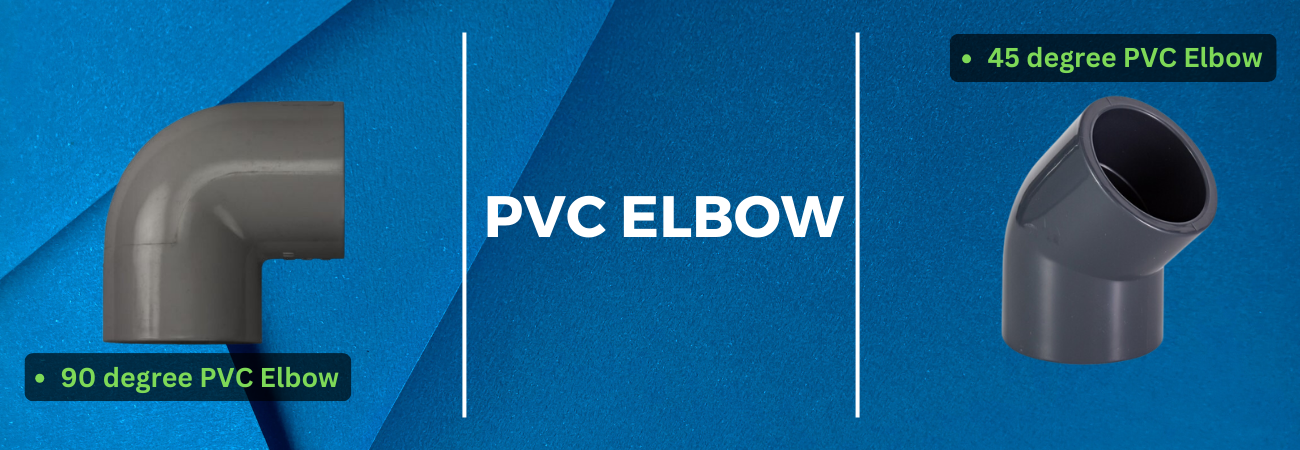
PVC elbows come in 90-degree as well as 45-degree angles, so you can direct your pipeline however you want according to your plumbing connection.
PVC Cross Tee
A Cross Tee is a type of pipe fitting that joins four pipe sections. Specifically, they have four slip connections that meet at 90 degree angles and look like a plus shape.
PVC Couplings & Union
Couplings are the most common and inexpensive PVC pipe fittings. They connect two pipes with each other or a pipe to a fitting permanently. In contrast, a union connects pipes and fittings but isn’t permanent, and you can detach it easily.
PVC Caps and Plugs
The role of a cap is very simple: to stop water flow. For example, you use them at the end of a pipeline that doesn’t need to connect to another pipe. Also, you can remove the cap later on to expand the pipeline. Meanwhile, caps stop the flow in pipes, while plugs stop the water flow in fittings.
PVC Adapters & Bushing
Adapters are versatile fittings that change the end type of the pipe, so it can connect to fittings and pipes of many sizes. Similarly, bushings function a lot like adapters, except that they focus on connecting pipes of different diameters. In particular, they achieve this by reducing the fitting size.
PVC Nipples
To connect two female ends of a PVC system, plumbers use nipples. Specifically, a nipple is a fitting with two male-threaded ends.
PVC Flanges
Also, flanges increase the strength of the pipe and are the fittings that allow the connection of accessories and other items to the pipes.
PVC Saddles
A PVC saddle tee is a PVC pipe fitting that lets you quickly add a tee to an existing PVC pipe, like those in irrigation systems. Additionally, these pipe fittings come in many sizes and work in both home plumbing and irrigation systems.
PVC Reducers
A PVC reducer is an accessory that joins two PVC pipes of different sizes, connecting a larger pipe with a smaller one. Joining two pipes with a reducer also requires solvent cement or rubber rings to make a leak-free joint. In addition, PVC reducers come in both eccentric and concentric types.
PVC Transition Fittings
Plumbers use transition fittings to move from steel pipe to polyethylene pipes. In fact, they’re a quick and easy way to connect various types of metallic pipes to PE pipe systems.
PVC Valves
PVC valves adjust the flow of fluids. Specifically, there are two types: throttling and non-return/isolation valves. First, throttling valves control the pressure and amount of liquid flowing in the pipe. Meanwhile, people also know non-return valves as check valves, which allow liquid to flow in one direction.
FAQs
The right PVC pipe size depends on the application, required water flow, pipe length, pressure, and connection requirements. For residential plumbing, drainage, irrigation, or other applications, check the recommended pipe diameter and pressure rating before installation.
Common PVC pipe sizes vary by application and manufacturer, with smaller diameters generally used for household plumbing and larger sizes used for irrigation, drainage, and water distribution. Always verify the required nominal size and specifications for your particular installation.
Yes. Pipe diameter can significantly influence flow and pressure loss. A smaller diameter may restrict flow over longer distances, while an appropriately sized pipe can help maintain efficient water movement. Pipe sizing should therefore consider both flow requirements and system pressure.
Check the manufacturer’s product specifications, markings on the pipe, and the nominal diameter mentioned on the packaging. Avoid selecting a pipe based only on its outside appearance, as nominal size, outside diameter, wall thickness, and pressure class can differ.
Yes. Water-supply systems and drainage applications have different design requirements. Water-supply pipes are selected based on factors such as pressure and flow, while drainage pipes primarily require suitable diameter, slope, and capacity for wastewater movement. Always select pipes according to the intended application and applicable standards.
For any queries, contact the plumbing experts at Ajay pipes on the Toll Free No. : 1800-11-4050 or via email at our email address info@ajaypipes.com



4 Comments