
cpvc coupling

CPVC Coupling

Introduction

AJAY FLOWLINE Plus:

Ajay flowline is a range of CPVC pipes and fittings by Ajay Pipes available all across the nation at more than 11 warehouses and more than 500 outlets.
Furthermore, Ajay is a 5 decade old, reliable brand, providing its customers with top-class products and services. Our core values at Ajay are customer satisfaction, honesty and integrity which encourages us to go an extra mile for the betterment of our products and services.
The products of Ajay have the following Advantages :

  • Made of virgin plastic, high quality raw materials
  • Do not support scaling
  • 100% leak proof
  • Fast and easy installation
  • High strength
  • Low thermal expansion
  • UV resistance
  • Rust and corrosion free
  • No scaling or pitting
  • Rigorous testing
  • Strict quality standards
  • Hot/cold water compatibility
  • Maintenance free systems
  • Cost-efficient
  • Chemical resistant
  • Low lifetime ownership cost

CPVC Coupler (also known as CPVC Socket) :

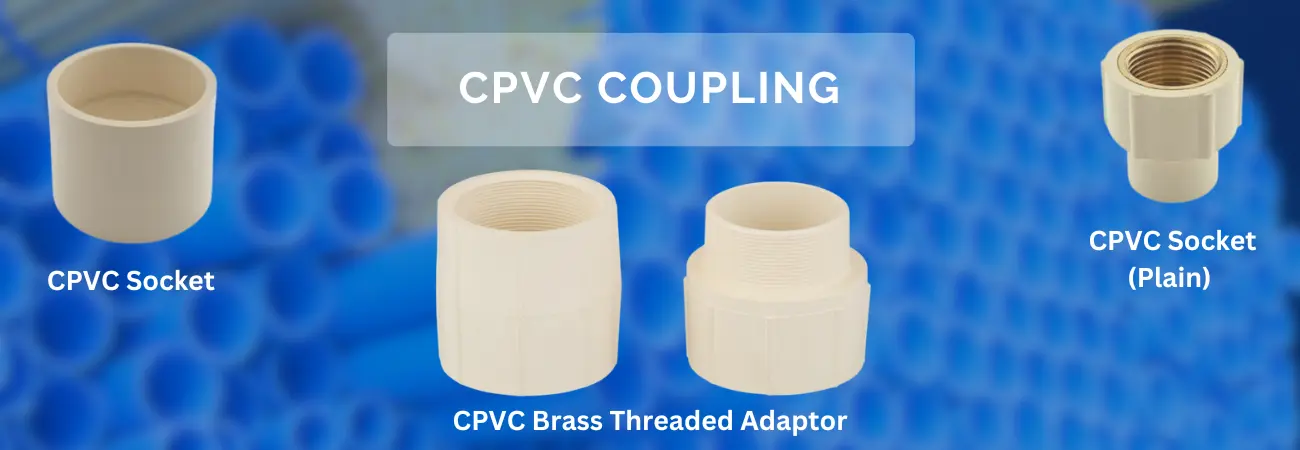
Couplers are fittings that connect two pipes together in order to extend the pipeline in one direction. CPVC Couplers are of two types plain couplers and threaded couplers which are sometimes also known as adaptors.
CPVC is chlorinated polyvinyl chloride plastic which is a high quality, strong plastic that withstands temperature upto 93 Deg C
CPVC Coupling

CPVC Coupler or Socket (Plain):

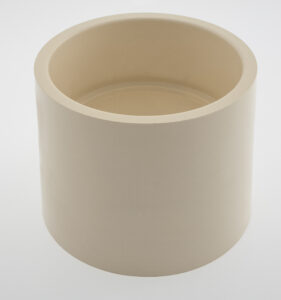
Plain Couplers have pipe joint on both sides using CPVC solvent cement. Sockets are also available in reducing type called CPVC Reducing Sockets or Couplers which connect a pipe of higher size with one of smaller size.

CPVC Coupler

CPVC Brass Threaded Adaptor:

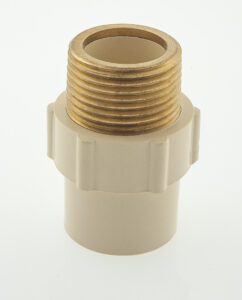
Brass threaded adaptors have brass threaded inserts on one end and CPVC on the other so as to connect the pipe to the bathroom fittings or other plumbing fixtures.
Brass threaded adaptors can be male threaded or female threaded.

CPVC Threaded Adaptor

CPVC Threaded Adaptor (plastic):

Plastic threaded adaptors available in both male and female threaded types have inner threads of CPVC as well as such one must be careful while tightening them with metallic plumbing fixtures. These kind of adaptors are not recommended for use with Hot water.

Our products are best suited for both homemakers and contractors or builders as they are affordable without compromising with the quality.

Standards for CPVC Couplers

● IS 17546: Chlorinated polyvinyl chloride (CPVC) fittings for potable hot and cold water distribution supplies — specification
● ASTM D2846: Specification for (Chlorinated Poly Vinyl Chloride) (CPVC) Plastic Hot & Cold water distribution systems. Material designation CPVC 4120.
● ASTM F438: Socket- Type Chlorinated Polyvinyl Chloride Plastic Pipe Fittings. Schedule 40
● ASTM F439: Socket-Type Chlorinated Polyvinyl Chloride Plastic Pipe Fittings. Schedule 80

CPVC Sockets are available in:
½” (15mm), ¾”(20mm), 1” (25mm), 1 ¼”(32mm), 1 ½”(40mm), 2” (50mm) in Copper tube sizes (CTS)
and 2 ½”(75mm), 3” (90mm), 4” (110mm), 6” (160mm) & 8” (200mm) in Iron Pipe sizes (IPS) Sch 40 and SCh 80.
CPVC Brass Threaded Adaptor

FAQs

1. What is a CPVC coupling, and where is it commonly used?

A CPVC coupling is a fitting used to join two CPVC pipes of the same diameter in a straight line. It is commonly used in residential, commercial, and industrial hot- and cold-water plumbing systems.

2. How do I choose the right CPVC coupling size?

Choose a coupling that matches the nominal size and compatible CPVC pipe system being installed. Checking the pipe and fitting specifications before installation helps ensure a proper joint and reduces the risk of leakage.

3. Can CPVC couplings be used for hot-water plumbing?

Yes. CPVC couplings are designed for CPVC plumbing systems that carry both hot and cold water. However, the coupling should always be selected according to the manufacturer’s rated temperature and pressure limits.

4. How should a CPVC coupling be installed to prevent leaks?

For a reliable joint, ensure the pipe ends are clean, properly cut, and correctly fitted before applying the manufacturer-recommended CPVC solvent cement. Proper insertion and curing time are also important for joint strength.

5. What should plumbers check when using CPVC couplings?

Plumbers should check pipe compatibility, fitting size, joint alignment, solvent-cement suitability, and the system’s operating temperature and pressure. Following the manufacturer’s installation instructions helps achieve a durable, leak-resistant connection.

For any queries, contact the plumbing experts at Ajay pipes on the Toll Free No. : 1800-11-4050 or via email at our email address info@ajaypipes.com

Similar Posts

Leave a Reply

Your email address will not be published. Required fields are marked *