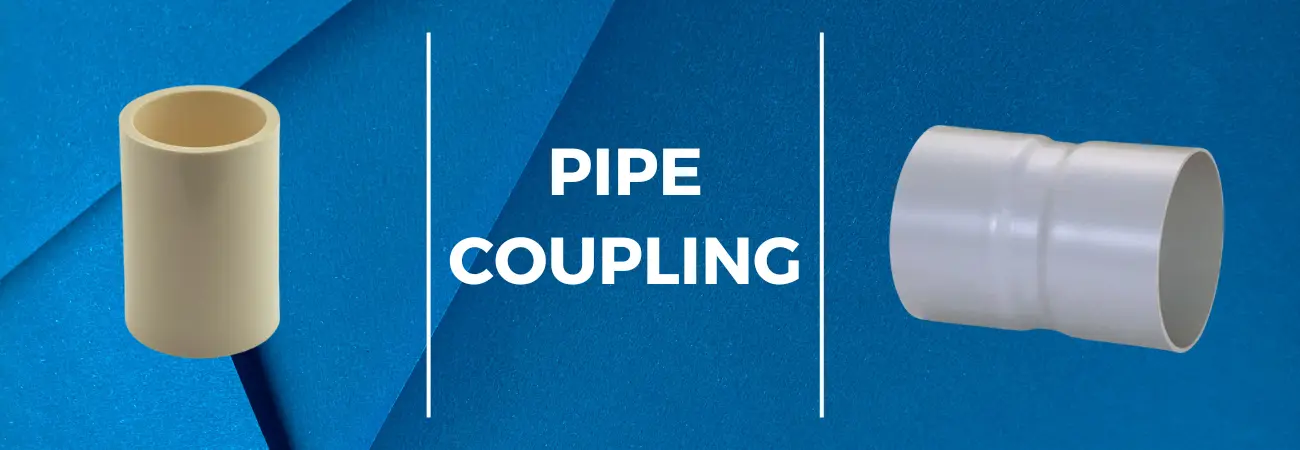
plumbing coupling
| | | |

Pipe Coupling

Introduction

What Is a Plumbing Coupling?

Plumbing couplings are among the most common pipe fittings. They permanently join one pipe to another and extend a pipeline in a straight line. Manufacturers make PVC couplings for use with PVC plumbing pipes. PVC, or polyvinyl chloride, is a strong, high-quality plastic that withstands temperatures up to 60°C. A coupling is simply a very short length of pipe with a socket at each end. Two main types exist: plain couplers and threaded couplers, which people also call adaptors.

pipes and fittings


Types of PVC Pipe Couplings

PVC Pipe Coupling or Socket (Plain)

Plain PVC couplings create a pipes joint on both sides using PVC solvent cement. Reducing sockets, also called reducing couplers, work the same way. However, they connect a larger pipe to a smaller one.

PVC Threaded Coupling or Adaptor (All Plastic)

All-plastic threaded adaptors come in male and female types, and both have PVC threads. Therefore, tighten them carefully against metal fixtures. We also do not recommend them for high-pressure applications.

PVC Brass Coupling or Brass Threaded Adaptor

A brass threaded adaptor has a brass insert on one end and PVC on the other. As a result, it connects pipes to bathroom fittings and other plumbing fixtures. You can choose male or female threads.

Available Sizes and Schedules

Ajay offers PVC plumbing couplings in Schedule 80 from ½” (15mm) up to 8″ (200mm). The range includes ½”, ¾”, 1″, 1¼”, 1½”, 2″, 2½”, 3″, 4″, 6″ and 8″. For low-pressure use, we also supply 2½” (75mm), 3″ (90mm) and 4″ (110mm) in Schedule 40.

Standards for PVC Pipe Couplings

Ajay couplings follow these ASTM specifications:

ASTM D 1784

Standard Specification for Rigid Poly(Vinyl Chloride) (PVC) Compounds and Chlorinated Poly(Vinyl Chloride) (CPVC) Compounds

ASTM D 2466

Standard Specification for Poly(Vinyl Chloride) (PVC) Plastic Pipe Fittings, Schedule 40

ASTM D 2467

Standard Specification for Poly(Vinyl Chloride) (PVC) Plastic Pipe Fittings, Schedule 80

ASTM D 2464

Standard Specification for Threaded Poly(Vinyl Chloride) (PVC) Plastic Pipe Fittings, Schedule 80

Where to Use PVC Couplings and Fittings

You can use PVC couplings wherever plumbing or pipe systems exist, for example in:

  • Individual residential units
  • Large residential complexes
  • Commercial buildings
  • Hotels and hospitals
  • Swimming pools
  • RO and DM water plants
  • Industrial applications (based on the chemical resistance chart)

For other applications, please check with an authorized Ajay representative.

Why Choose Ajay Greenline UPVC Pipes and Fittings?

Ajay Greenline uses a non-toxic, lead-free plastic compound, which makes it safer for plumbing. In addition, all our UPVC pipes and fittings resist bacterial growth. Greenline is also more resilient than metal or concrete systems, so it lasts longer.

FAQs

1. What is a pipe coupling used for?

A pipe coupling is a short fitting with a socket on both ends, used to permanently join two pipes together and extend a pipeline in one direction. PVC couplings use solvent cement on both ends and are rated for temperatures up to 60°C.

2. What is the difference between a plain coupling and a threaded coupling?

A plain PVC coupling (socket) joins two pipes permanently using solvent cement on both ends, while a threaded coupling, also called a threaded adaptor, connects a pipe to a fixture using threads instead. Threaded adaptors come in male and female types and are not recommended for high-pressure applications.

3. What is a PVC reducing socket?

A PVC reducing socket, or reducing coupler, is a coupling designed to connect a pipe of a larger diameter to one of a smaller diameter within a single fitting. This lets a plumber transition pipe sizes without needing a separate reducer bushing.

4. What is the difference between a plastic threaded adaptor and a brass threaded adaptor?

A plastic (all-PVC) threaded adaptor has PVC threads on both the male and female sides and needs careful, not over-tightened, installation against metallic fixtures. A brass threaded adaptor has a brass threaded insert on one end and PVC on the other, giving it more durable, wear-resistant threads for connecting to bathroom fittings or other plumbing fixtures.

5. What sizes are PVC pipe couplings available in?

PVC pipe couplings are available in Schedule 80 from ½” (15mm) up to 8″ (200mm), including ½”, ¾”, 1″, 1¼”, 1½”, 2″, 2½”, 3″, 4″, 6″ and 8″. In Schedule 40, they’re available in 2½” (75mm), 3″ (90mm) and 4″ (110mm) for low-pressure applications only.

For any queries, contact the plumbing experts at Ajay pipes on the Toll Free No. : 1800-11-4050 or via email at our email address info@ajaypipes.com

Similar Posts

Leave a Reply

Your email address will not be published. Required fields are marked *