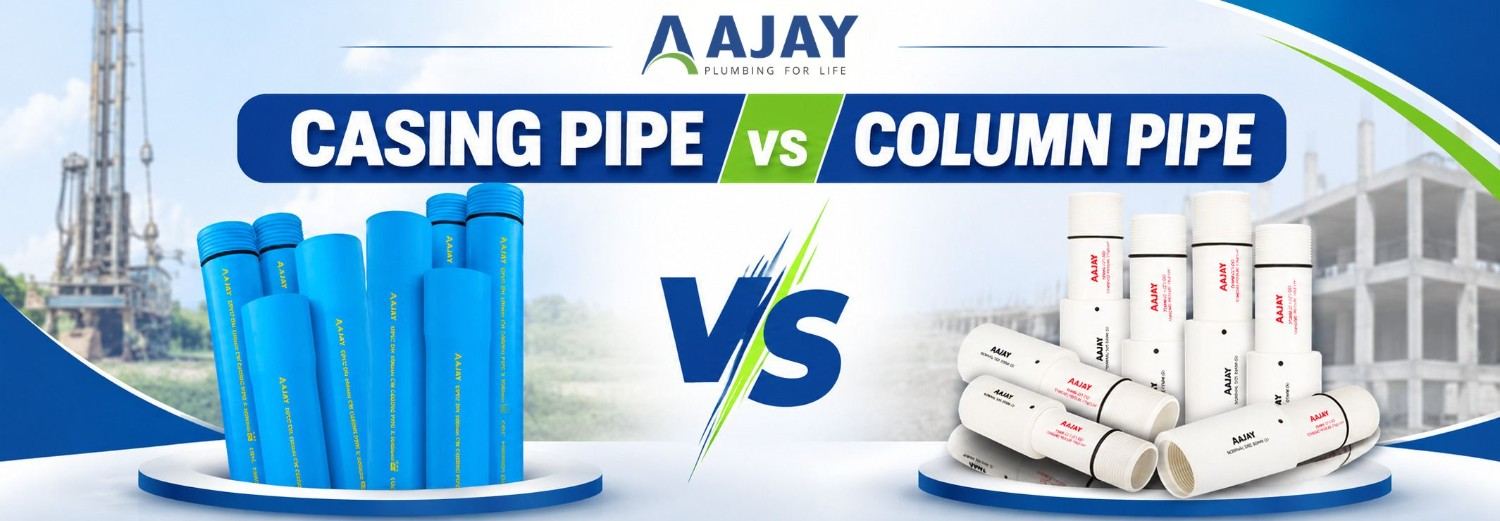
Casing Pipe vs Column Pipe: Which One Does Your Borewell Need?
Introduction
Ask ten borewell owners what the pipes inside their borewell do, and a few will say they’re “all the same thing.” They aren’t. The casing pipe vs column pipe question comes up often, and a wrong choice can mean a collapsed borewell, a burnt pump, or water that never reaches your tank.
This guide explains what each pipe does, where it sits, how the two differ, and how to choose between them.
What Is a Casing Pipe?
A casing pipe is the permanent lining of a borewell. Once the hole is drilled, the casing goes in to hold the walls in place. Without it, loose soil, sand, and soft rock can cave in and block the water source.
Casing pipe does four main jobs:
- It keeps the borewell wall from collapsing.
- It stops sand, silt, and loose soil from entering the bore.
- It keeps surface contamination away from groundwater.
- It gives the pump a stable, protected space to work in.
Casing pipes have a wider diameter and are usually installed once, to last for years. In shallow or soft-soil areas, the casing may run the full depth. In hard rock areas, it often covers only the upper loose portion.
What Is a Column Pipe?
A column pipe (also called a riser pipe) is the pipe that carries water from the submersible pump up to the surface. It sits inside the casing and connects to the pump at the bottom.
In simple terms, the casing protects the borewell, and the column pipe delivers the water.
Column pipes are narrower than casing pipes. They are usually joined in sections with threaded ends, so installers can lower the pump to the right depth and pull it back up for repairs. Because they carry pressurised water and the weight of the pump, they need to be strong and have well-cut threads.
Casing Pipe vs Column Pipe: The Core Differences
| Feature | Casing Pipe | Column Pipe |
|---|---|---|
| Main Purpose | Supports and protects the borewell wall | Carries water from the pump to the surface |
| Position | Lines the borewell itself | Hangs inside the casing, attached to the pump |
| Diameter | Larger | Smaller |
| Pressure | Not designed to carry pressurised water | Built to handle water pressure |
| Joints | Usually socket, solvent, or threaded joints | Threaded joints for easy assembly and removal |
| Replacement | Rarely replaced | Can be pulled out and reworked during pump servicing |
The simplest way to remember it: casing is the wall, column is the water line. One protects the borewell, and the other moves the water.
Why Do People Confuse Them?
The confusion usually comes from three things.
- Both are pipes in the same borewell. From the surface, you only see the top of each one.
- Both come in similar materials, such as uPVC and metal, so they look alike on a shop shelf.
- Borewell packages are often sold together, which blurs the line between the two products.
Treating them as interchangeable is a costly mistake. A casing pipe isn’t built for the pressure and threading a column pipe needs, and a column pipe is too narrow to hold a borewell wall.
Common Materials for Borewell Casing and Column Pipes
Most borewell casing and column pipes today are made from one of two material families.
uPVC pipes are popular because they resist rust and corrosion, don’t react with most groundwater, and are lighter to handle and install. Many farmers and homeowners choose them for borewells where water has high mineral content.
Metal pipes (such as GI or MS) are chosen where extra mechanical strength is needed, often in deep or demanding installations. They can corrode over time, depending on water chemistry, so water quality matters here.
The right material depends on your borewell depth, soil type, water quality, and budget. If you’re unsure, a soil and water test before installation can save you real money later.
How to Choose the Right Casing Pipe
Before you buy casing pipe, check these points:
- Soil and rock condition. Loose or sandy soil needs deeper casing, while hard rock may need less.
- Borewell diameter. The casing must match the drilled bore, and it must leave room for the pump.
- Wall thickness. Thicker walls resist the pressure of the surrounding earth.
- Water quality. Choose a material that won’t corrode or react with your groundwater.
- Standards compliance. Look for pipes made to recognised Indian standards, and ask for test certificates.
How to Choose the Right Column Pipe
For column pipe, focus on these points:
- Size compatibility with your pump. The pipe diameter must match the pump’s outlet and fit comfortably inside the casing.
- Thread quality. Clean, accurate threads prevent leaks and make future removal easier.
- Pressure rating. The pipe must handle your pump’s discharge pressure.
- Length and sections. Plan the number of sections for your pump setting depth.
- Strength under load. The string of pipe has to support the pump’s weight without bending or cracking.
Common Mistakes to Avoid
Using the wrong diameter combination. If the column pipe and pump are too wide for the casing, the pump can jam or be hard to remove.
Skimping on thread quality. Poor threads lead to leaks, lost pressure, and a pipe string that can separate underground.
Ignoring water chemistry. Corrosive or high-mineral water shortens the life of unsuitable pipe materials.
Buying only on price. Cheaper pipe with weak walls can fail underground, where repair is expensive and difficult.
Skipping professional advice. Borewell conditions differ from plot to plot. Local drillers and pipe suppliers know the typical depth and soil in your area.
Casing Pipe vs Column Pipe: Which One Do You Need?
In most borewells, you need both, and each has a different job.
- If you are drilling a new borewell, you need casing first, then column pipe for the pump.
- If your water output has dropped or the pump needs servicing, you likely need to check or replace the column pipe.
- If the borewell walls are caving in or silt is entering the water, the casing needs attention.
- If you are upgrading to a larger pump, check that your casing diameter can accommodate it, and match the column pipe to the new pump.
Conclusion
Casing pipe and column pipe work as a team. Casing keeps the borewell standing and clean, and column pipe moves the water from deep underground to your tank. Choosing the right size, material, and quality for each protects your investment and keeps your water supply steady for years.
Need help choosing the right borewell casing and column pipes? Visit ajaypipes.com to explore the pipe range, compare options, and get in touch with the team for guidance suited to your borewell.
FAQs
Casing pipe lines and supports the borewell wall, while column pipe carries water from the submersible pump to the surface. Casing is wider and permanent, and column pipe is narrower and threaded for easy removal.
No. Casing pipe isn’t built for pressurised water flow or for the threaded, load-bearing role of a column pipe. Using it this way risks leaks, poor performance, and pipe failure.
Most do. Casing protects the bore from collapse and contamination, and column pipe is needed wherever a submersible pump delivers water. In very hard rock, casing may be needed only for the upper section.
It depends on your conditions. uPVC resists rust and corrosion and is easy to handle, while metal pipes offer extra mechanical strength. Soil, depth, water quality, and budget should guide your choice.
Start with your borewell diameter and pump size. The casing must match the bore, and the column pipe must fit your pump outlet and sit comfortably inside the casing. A trusted supplier or driller can confirm the exact fit.
For any queries, contact the plumbing experts at Ajay pipes on the Toll Free No. : 1800-11-4050 or via email at our email address enquiry@ajaypipes.com