What Are SWR Pipe Fittings? A Practical Guide to Types, Sizes and Selection
Introduction
Drainage looks simple until a joint leaks behind a finished wall. Then the repair becomes expensive, messy, and slow. Choosing the right SWR pipe fittings at the start prevents most of these problems.
This guide explains what SWR pipe fittings are, which types you will meet on site, how to choose good ones, and how to install them correctly.
What Are SWR Pipe Fittings?
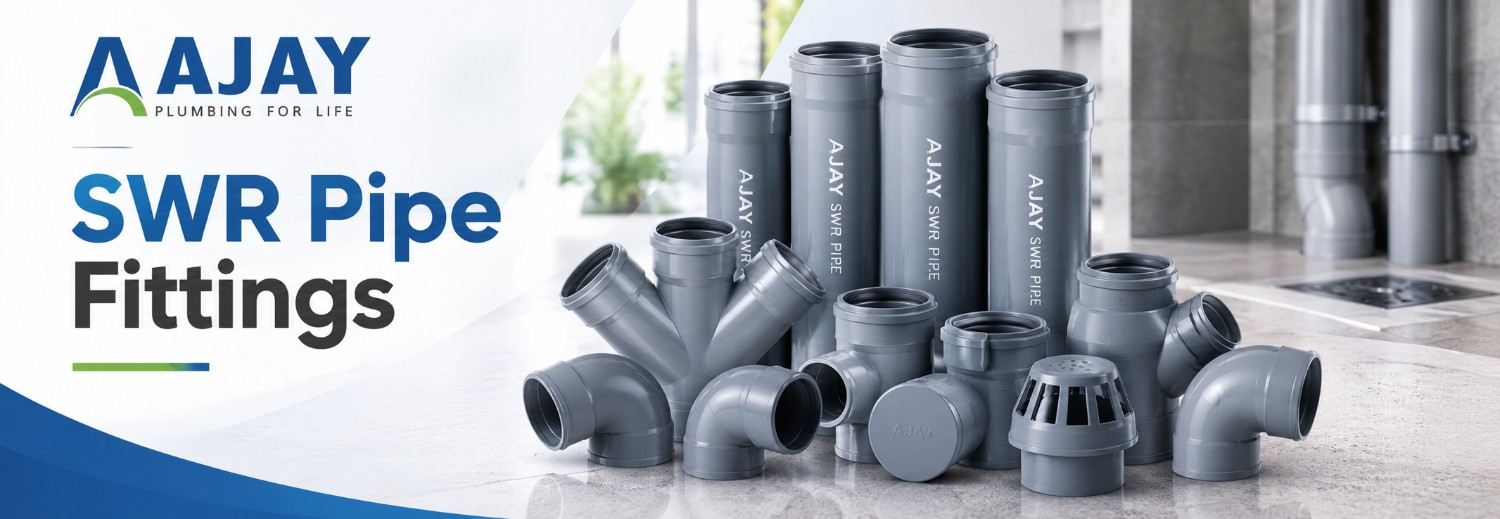
SWR stands for Soil, Waste, and Rainwater. SWR pipe fittings connect drainage pipes, change their direction, create branches, and seal open ends. Together, they carry wastewater from toilets, basins, kitchens, and roofs to the sewer line or septic tank.
Drainage runs on gravity, not pressure. For this reason, SWR fittings have smooth internal curves and wide bores, so waste flows freely without clogging. Most Indian buildings now use PVC for this job.
Why Do Builders Prefer PVC SWR Fittings?
Cast iron once dominated drainage. PVC has largely replaced it, and the reasons are practical:
- Corrosion resistance: PVC does not rust or react with detergents, household chemicals, or sewage gases.
- Light weight: Crews transport and install it faster, which lowers labour cost.
- Smooth inner surface: Waste slides through without sticking, so blockages happen less often.
- Long service life: Good-quality PVC lasts for decades with little maintenance.
- Lower cost: Material and installation both cost less than metal alternatives.
For homes, apartments, offices, and factories, PVC SWR pipes and fittings offer a dependable balance of strength and affordability.
What Are the Common Types of SWR Pipe Fittings?
Knowing the vocabulary saves time when you order material or brief your plumber. The table below covers the fittings you will use most.
| Fitting | What It Does | Best Used For |
|---|---|---|
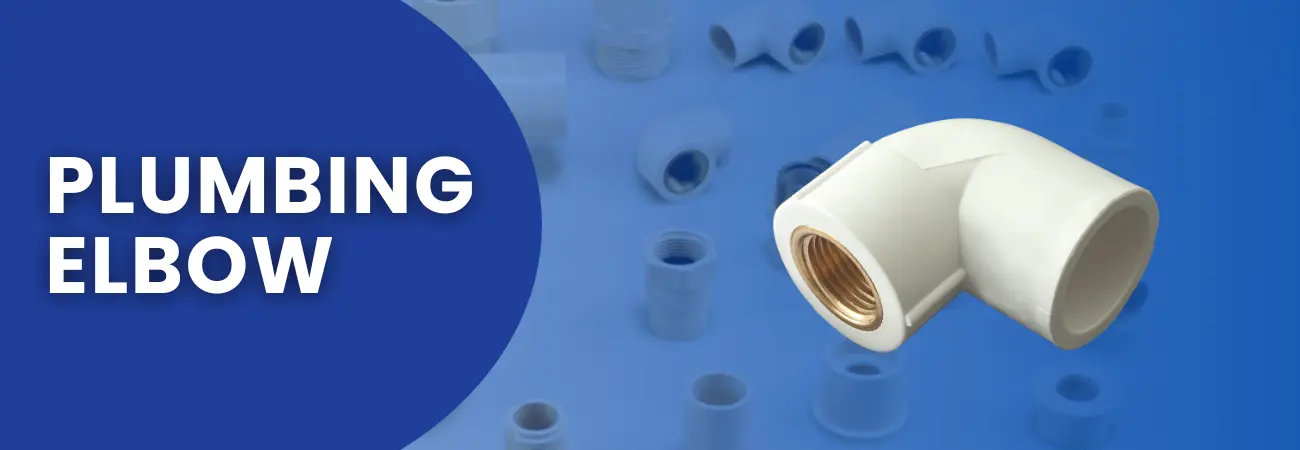
| Bends (45° and 90°) | Change the pipe direction | Long-radius bends suit horizontal drains because they keep flow smooth. |
| Tees and Y-tees | Create branch connections | A Y-tee guides waste along the flow direction, so it is preferable to a straight tee on most branches. |
| Couplers | Join two pipes of the same diameter | Extending or repairing straight runs. |
| Reducers | Connect pipes of different sizes | A branch line meeting a main stack. |
| Door bends and door tees | Provide an access cover for cleaning | Points where blockages are likely. |
| P-traps and S-traps | Hold a small water seal that blocks sewer gas | Under basins, sinks, and bathroom fixtures. |
| Floor traps and Nahani traps | Collect water from floors | Bathrooms and kitchens. |
| End caps and plugs | Seal pipe ends | Pressure testing or future extensions. |
| Vent cowls | Let air in and gas out | Top of the soil stack. |
How Do SWR Fittings Work Inside a Drainage System?
Picture the path of wastewater from a bathroom. A basin or floor drain first discharges through a trap, which holds a water seal against sewer gas. P-traps keep a seal of at least 50 mm, so gas stays out of the room. The water then enters a branch line, which joins the vertical soil stack through a Y-tee. The stack drops to the underground drain, and a vent cowl at its top lets air in so the water seals do not siphon out. Bends change direction along the way, and door tees give access when something blocks the line.
Every fitting plays a role in this chain. One weak joint or a missing vent affects the whole system.
How Do You Choose the Right SWR Pipe Fittings?
Not all fittings are equal, even when they look identical. Check these six points before you buy.
- Match the pipe size. Common SWR diameters are 75 mm, 90 mm, 110 mm, and 160 mm. The fitting must match the pipe exactly, because a slightly loose socket becomes a leak later.
- Check the standards. In India, SWR pipes follow IS 13592 and SWR fittings follow IS 14735. Look for the ISI mark, and confirm licence details on the Bureau of Indian Standards website. Certified products meet set limits for dimensions, wall thickness, and impact strength.
- Compare the wall thickness. Thin walls crack under load or during backfilling. Ajay Drainline pipes come in Type A and Type B, and Type B has thicker walls in every size. In 110 mm, for example, Type A runs about 2.2 to 2.7 mm, while Type B runs about 3.2 to 3.8 mm. A sturdy fitting also has uniform thickness around the socket.
- Inspect the finish. Quality fittings have smooth surfaces, clean edges, and no air bubbles, warping, or rough seams.
- Pick the right sealing system. Ring-fit and solvent-cement joints behave differently, so choose based on your building design.
| Feature | Ring-fit (Rubber Ring) | Solvent-cement |
|---|---|---|
| Joint Type | Push-fit with a rubber seal | Permanent chemical bond |
| Thermal Movement | Allows expansion and contraction | Rigid, with little flexibility |
| Installation | Quick and simple | Needs cleaning, cement, and curing time |
| Dismantling | Easy to take apart | Cannot be reversed |
| Ideal For | Long vertical stacks and exposed runs | Concealed lines and branch connections |
- Buy from a trusted manufacturer. Uncertified fittings often use recycled or filler-heavy material. They look fine on day one and fail by year three.
How Do You Install SWR Pipe Fittings Without Costly Mistakes?
Even the best fittings fail when the installation is poor. Follow these steps:
- Maintain the slope. Horizontal drains need a gentle fall, generally between 1:40 and 1:60, so gravity moves the waste.
- Cut square and deburr. Angled cuts and sharp edges weaken the joint and trap debris.
- Dry-fit first. Test the assembly before you apply solvent cement.
- Use the right solvent cement. Apply it evenly, push the pipe in with a slight twist, and hold it for a few seconds.
- Leave an expansion gap. On ring-fit joints, keep about 10 mm of gap at the socket base so the pipe can expand.
- Support the pipes. Fix clamps at proper intervals to stop sagging on long horizontal runs.
- Pressure-test before concealing. Run a water or air test before plastering or tiling.
Which Common Mistakes Should You Avoid?
Four errors appear again and again on site: mixing fittings made to different standards, skipping vent pipes, using 90° elbows where long bends belong, and leaving no access points for cleaning. Each one costs little to avoid during installation and a lot to correct later.
Vent pipes deserve special attention. Without them, a flushing toilet can pull the water out of nearby traps, and sewer gas then enters the room. Mixed standards cause a different problem: a socket from one maker may not seat fully on a pipe from another, so the joint leaks under load. Finally, plan access points at every change of direction on a long drain, because a blocked line without a cleaning point means opening the wall.
Where Can You Buy Reliable SWR Pipe Fittings?
A good drainage system uses components that fit together, perform consistently, and carry proper certification. Ajay Pipes manufactures Drainline PVC SWR pipes and fittings in ring-fit and solvent-fit options, in 75, 90, 110, and 160 mm sizes. Browse the full Ajay Pipes catalogue to check specifications, then contact the team for project quotes and technical guidance.
FAQs
They connect, redirect, branch, and seal drainage pipes that carry soil, waste, and rainwater in homes, offices, and factories.
SWR pipes carry drainage by gravity and have thinner walls and larger diameters. UPVC and CPVC pressure pipes carry supply water under pressure, so their walls and joints differ.
Ring-fit joints allow movement and easy dismantling, so they suit long stacks. Solvent-cement joints bond permanently, so they suit concealed lines and branches.
Quality PVC SWR fittings commonly last several decades when installed correctly and shielded from long direct sunlight.
Standard PVC SWR fittings handle normal household drainage, but sustained very hot discharge can soften them. Check the manufacturer’s temperature rating before you use them for hot waste.
For any queries, contact the plumbing experts at Ajay pipes on the Toll Free No. : 1800-11-4050 or via email at our email address enquiry@ajaypipes.com