Agriculture PVC Pipe: Types, Sizes, Uses and Price Tips
Introduction
A pump hums through a May afternoon, the soil cracks at the edges, and water finally creeps toward the far corner of the plot. Then a joint pops, and the afternoon is gone. Most farmers have lived some version of this day. The culprit is rarely bad luck. It is usually a pipe chosen in a hurry. Agriculture PVC pipe can prevent that scene, provided you pick the size, the class and the finish with care. This guide shows you how to do that.
Why Does Agriculture PVC Pipe Last Longer in Farm Conditions?
A farm pipe leads a hard life. It sits in damp soil for years, meets fertiliser salts, and often crosses open ground where the sun bakes it daily. Metal pipe slowly loses wall thickness under these conditions. PVC behaves differently. Its wall keeps the same thickness season after season, and nothing flakes off to narrow the passage inside.
That steady bore also saves money. Smooth walls let water pass with less drag, so the pump spends less energy on every litre it moves. Light weight adds a second saving, because two people can carry a full length without help from a machine. Solvent cement completes the picture by fusing separate lengths into one continuous line.
Borewell water adds another test, since dissolved salts attack many metals but leave PVC alone. Sunlight remains the one real enemy. Long exposure makes ordinary PVC brittle. So specify UV stabilised pipe made from virgin compound wherever the line rises above the soil.
How Do You Read the Label on Agriculture PVC Pipe?
The printing along a pipe tells you more than any sales pitch. Check four details before you accept a delivery.
- The standard: Farm pressure pipe should refer to IS 4985, a specification from the Bureau of Indian Standards.
- The ISI mark: It shows that the maker holds a licence and tests its batches.
- The pressure class: Ajay Agriline offers 2.5, 4, 6 and 10 kg/cm2.
- The outer diameter: Agriline runs from 20 mm to 315 mm, in lengths of 3 m and 6 m.
Also scan each length for dents, cracks and chipped socket ends, because transport damage shows up there first. If the label and your order disagree, send the stock back. A wrong class on the pipe means a wrong pressure limit in the field.
How Do You Choose the Right Agriculture PVC Pipe for Your Pump?
Ask three questions before you place an order.
What pressure does the pump create at its outlet? Choose a class that clears this figure with room to spare. A valve that closes quickly sends a sharp spike through the pipe, and thicker walls absorb that shock better.
How far must the water travel? Long runs lose more energy to friction. Therefore, step up one diameter on long stretches. A wider pipe costs more at purchase, yet the power it saves can repay the difference over the seasons.
How often does the line run? A system that works every day goes through many pressure cycles. In that case, lean toward the higher class.
Which Irrigation Pipes Belong in Which Part of the Farm?
Few farms rely on a single material. The table below shows where each type earns its place.
| Pipe | Strength | Weak spot | Best role |
|---|---|---|---|
| PVC | Rigid, steady bore, no rust | Needs sun protection above ground | Mainlines and sub-mains |
| HDPE or LDPE | Flexible, coils, easy to route | Hard to hold a fixed, straight alignment | Drip laterals and lines that move |
| GI | Shrugs off knocks | Rusts and adds weight | Short exposed stretches near the pump |
A mixed layout works best. Run rigid PVC pipe for irrigation from the source to the edge of the plot. Then hand over to flexible lines inside the plot, where you may need to shift them between crops.
What Shapes the Agricultural PVC Pipes Price List?
Four levers move almost every quote. Diameter and class decide how much compound each metre contains, so they set the base rate. Compound grade comes next. Virgin resin costs more than recycled filler, but it resists cracking for much longer. Certification adds a cost as well, because ISI batches pass formal tests. Finally, accessories, order quantity and freight shape the invoice total. Bends, tees, reducers and cement all count here.
Treat the quote as a decade long decision. Divide the price by the number of seasons the line will serve. A thicker pipe that lasts ten years often costs less per season than a thin one you replace twice. For current rates on your size and class, ask the Ajay Pipes team and share your requirement.
How Do You Install PVC Pipe for Irrigation That Lasts?
Even a sound pipe leaks when the work is rushed. Store the lengths flat and in shade until laying day, then follow this order on site.
- Survey the route. Mark the pump, valves and outlets, and choose the straightest path between them.
- Prepare the trench. Clear stones from the bed, and dig deep enough to keep the pipe clear of ploughs and wheels.
- Cut and dry. Cut each end square, then wipe the socket and the spigot until both are bone dry.
- Join with cement. Brush on an even coat, seat the joint fully, and hold it still for a few seconds.
- Wait. Let the joint cure for the time printed on the cement pack.
- Test and cover. Fill the line, check the pressure, inspect each joint, and backfill in layers.
Two finishing touches help. First, fit air release valves at high points, because trapped air creates pressure spikes. Second, anchor bends and end caps firmly, since moving water pushes hardest at those spots.
Which Habits Quietly Shorten the Life of Irrigation Pipes?
Small habits cause most early failures. Avoid these four.
- Starting the pump on a shut line. Open valves slowly so water fills the pipe gently.
- Choosing a class by guesswork. A rating below pump pressure invites cracks.
- Leaving long runs in full sun. Shade or bury them, even when the pipe is UV stabilised.
- Skipping the pressure test. One weak joint can drain a whole line.
Why Do Farmers Choose Ajay Agriline?
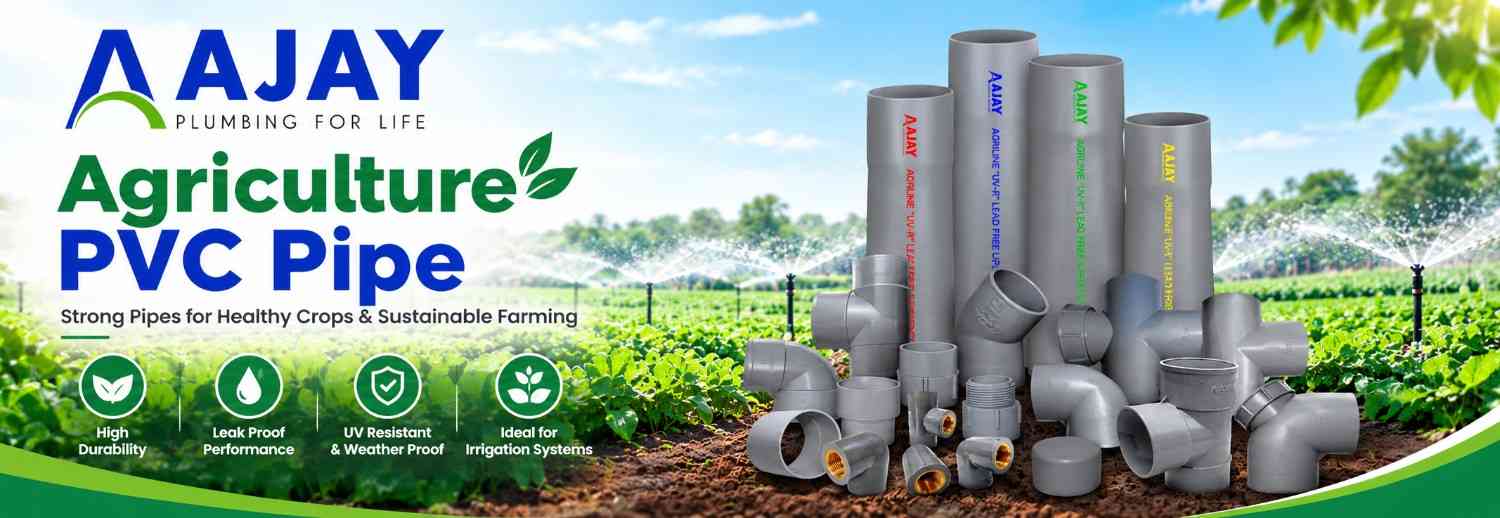
Ajay Pipes has manufactured pipes for over 50 years and is the oldest PVC pipe ISI licence holder in India. The Agriline range serves irrigation, water supply and industrial process lines. Pipes follow IS 4985, fittings follow IS 7834, and the compound is virgin and UV stabilised. Each pipe arrives pre-socketed, ready for solvent cement.
Because the range spans 20 mm to 315 mm, one supplier can cover your borewell line, your mainline and your field outlets. Every part then fits the next. Browse sizes and classes on the Ajay Agriline page.
Conclusion
Good agriculture PVC pipe pays you back in saved water, saved power and fewer emergency repairs. Read the label, match the class to the pump, plan for the sun, and lay every joint with patience. Your pipes will then work quietly while you tend the crop.
FAQs
They use it to carry water from borewells, open wells and canals to the field. It also serves water supply and process lines.
Yes. It resists rust, keeps a smooth bore and suits mainlines and sub-mains. Choose UV stabilised pipe for any section above ground.
Rates change with size, class and quantity. Send your requirement to the Ajay Pipes team to receive a current list.
Select a class above the pump’s working pressure, with a safety margin. Ajay Agriline offers 2.5, 4, 6 and 10 kg/cm2.
Life depends on pipe quality, joint quality and sun exposure. Certified pipe with clean joints, buried or UV stabilised, can serve for many years.
For any queries, contact the plumbing experts at Ajay pipes on the Toll Free No. : 1800-11-4050 or via email at our email address enquiry@ajaypipes.com