Introduction
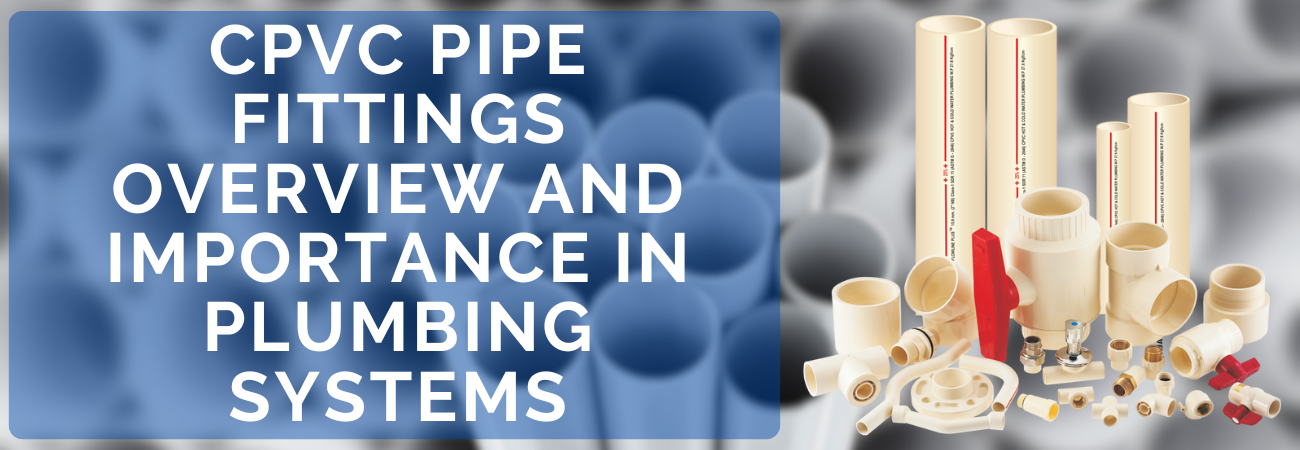
CPVC pipes and fittings are an essential part of modern plumbing systems. CPVC (Chlorinated Polyvinyl Chloride) is a strong and heat-resistant plastic material widely used for hot and cold water supply systems in residential, commercial, and industrial buildings.
If you are searching for CPVC Pipe Fittings Names PDF, this guide will help you understand the different types of CPVC fittings used in plumbing systems. In this article, we will cover the CPVC pipe fittings list, explain the uses of CPVC plumbing fittings, and provide a simple CPVC pipe fittings chart to make it easier to understand their functions.
In a plumbing system, pipes alone cannot form a complete network. Various fittings are required to connect pipes, change directions, control water flow, or divide pipelines. CPVC pipe fittings help create a reliable and efficient water distribution system.
Download the PDF:
CPVC Pipe Fittings Names PDF
What Are CPVC Pipe Fittings?
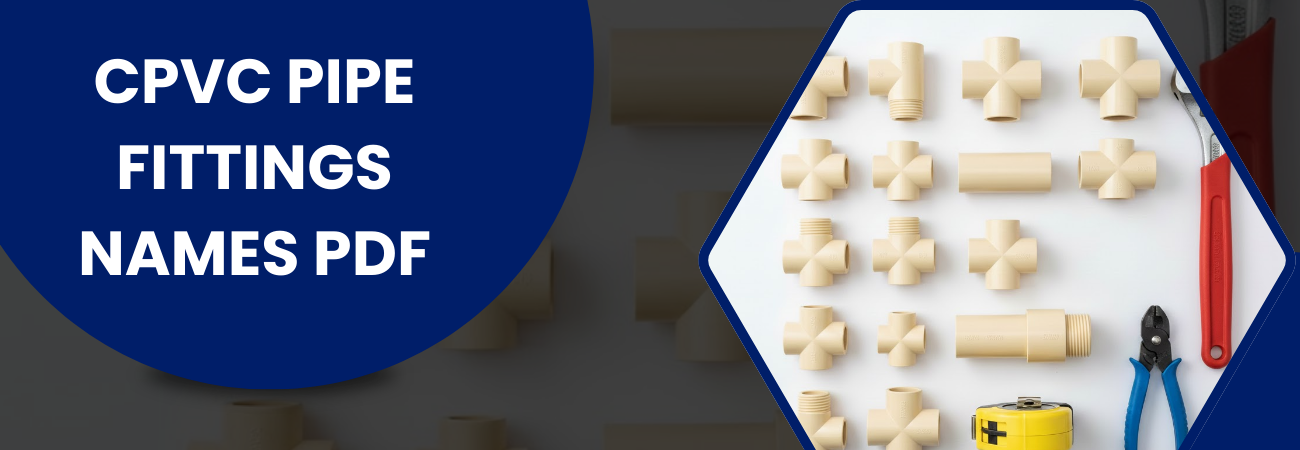
CPVC pipe fittings are components used to connect CPVC pipes and build a complete plumbing system. These fittings allow pipes to change direction, split water flow, reduce pipe size, or close the pipe end.
Today, CPVC plumbing fittings are widely used in different applications such as:
- Residential water supply systems
- Commercial plumbing networks
- Industrial pipelines
- Hot and cold water distribution
- Water treatment plants
One of the biggest advantages of CPVC fittings is their ability to handle high temperatures and pressure without corrosion.
CPVC Pipe Fittings List
Below is a commonly used CPVC pipe fittings list used in plumbing installations.
1. CPVC Elbow
The elbow fitting is used to change the direction of the pipe. It is commonly available in 45-degree and 90-degree angles.
2. CPVC Tee
A tee fitting connects three pipes and helps divide water flow into two directions.
3. CPVC Coupling
Coupling fittings are used to connect two pipes of the same size in a straight line.
4. CPVC Union
Union fittings allow easy pipe removal and maintenance without cutting the pipeline.
5. CPVC Reducer
A reducer connects pipes of different sizes and reduces the flow from a larger pipe to a smaller one.
6. CPVC End Cap
End caps are used to close the end of a pipe to stop the flow of water.
7. CPVC Cross
Cross fittings connect four pipes together and are used in complex plumbing networks.
8. CPVC Adapter
Adapters help connect CPVC pipes to threaded fittings or metal pipes.
9. CPVC Bushing
Bushings reduce the opening size of a pipe fitting.
10. CPVC Ball Valve
A ball valve is used to control or stop the flow of water in a pipeline.
These fittings are essential for creating a flexible and leak-proof plumbing system.
CPVC Pipe Fittings Chart
Understanding a CPVC pipe fittings chart makes it easier to identify each fitting and its function.
CPVC Fitting | CPVC Fitting |
|---|---|
Elbow | Changes pipe direction |
Tee | Divides water flow |
Coupling | Connects two pipes |
Reducer | Connects different pipe sizes |
Union | Allows pipe disconnection |
End Cap | Closes pipe end |
Cross | Connects four pipes |
Advantages of CPVC Plumbing Fittings
There are several reasons why CPVC plumbing fittings are widely used in modern plumbing systems.
1. High Temperature Resistance
CPVC fittings can withstand temperatures up to 93°C, making them suitable for hot water supply systems.
2. Corrosion Resistant
Unlike metal pipes, CPVC fittings do not rust or corrode over time.
3. Easy Installation
CPVC pipe fittings can be installed using solvent cement, which makes installation quick and simple.
4. Long Lifespan
A well-installed CPVC plumbing system can last 40–50 years or more.
5. Smooth Internal Surface
The inner surface of CPVC pipes and fittings prevents scaling and ensures smooth water flow.
Applications of CPVC Pipe Fittings
CPVC pipe fittings are used in many industries and buildings, including:
Residential homes
Commercial buildings
Hospitals
Hotels
Industrial facilities
Agricultural irrigation systems
Because of their durability and chemical resistance, CPVC fittings are considered one of the most reliable plumbing solutions.
Conclusion
CPVC pipe fittings are a vital part of any plumbing system. Fittings like elbows, tees, couplings, reducers, and adapters help connect pipes and ensure proper water flow throughout the system.
Understanding the CPVC pipe fittings list and the CPVC pipe fittings chart helps plumbers, contractors, and homeowners choose the right fittings for their projects. With their durability, corrosion resistance, and easy installation, CPVC plumbing fittings remain one of the best choices for modern plumbing systems.
If you are looking for a CPVC Pipe Fittings Names PDF, this guide provides a simple overview of the most common CPVC fittings used in plumbing.
FAQ:-
1. What are CPVC pipe fittings?
CPVC pipe fittings are components used to connect, control, and redirect CPVC pipes in plumbing systems.
2. What are the most common CPVC pipe fittings?
The most common fittings include elbows, tees, couplings, reducers, unions, adapters, and end caps.
3. Are CPVC fittings suitable for hot water?
Yes, CPVC fittings are designed to handle high temperatures and are widely used in hot water supply systems.
4. Where can I find a CPVC pipe fittings chart?
You can find a CPVC pipe fittings chart in plumbing guides, manufacturer catalogs, and downloadable PDFs.
5. Why are CPVC plumbing fittings popular?
CPVC fittings are lightweight, corrosion-resistant, durable, and easy to install, making them ideal for modern plumbing systems.
For any queries, contact the plumbing experts at Ajay pipes on the Toll Free No. : 1800-11-4050 or via email at our email address info@ajaypipes.com