What Is CPVC Solvent Cement and How Do You Use It for Leak-Proof Joints?
CPVC solvent cement decides whether a hot water line lasts for decades or leaks within a season. Most joint failures trace back to the cement step, not the pipe. Therefore, plumbers and homeowners both need to know how to choose it, apply it, and cure it correctly. This guide explains the process in plain steps. It also shares curing times, can coverage, and pack sizes from the Ajay Flowline Plus range.
What is CPVC solvent cement?
CPVC solvent cement is a liquid that welds CPVC pipes and fittings together. It softens the plastic surfaces on contact. As the solvent evaporates, the two parts fuse into one continuous piece. In other words, the joint is a chemical weld, not a glued seam.
People often call the product CPVC solvent, and both names mean the same thing. Cement for potable water systems follows ASTM F493, the standard for CPVC solvent cements. Ajay states that its Flowline Plus solvent cement is tested and certified by NSF of IAPMO India. You will use it with CPVC pipes and fittings in any plumbing system that carries hot and cold water.
Do you need primer with CPVC solvent cement?
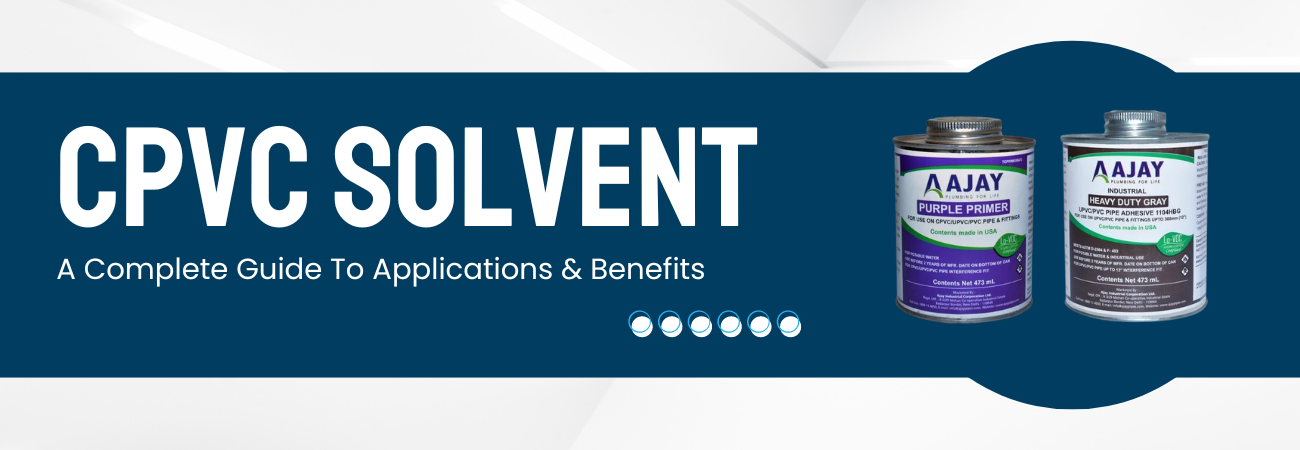
The answer depends on the pipe size. For the common sizes up to 2 inches, Flowline Plus cement works as a one-step, low-VOC product. For sizes above 2 inches, Ajay recommends purple primer and heavy duty gray solvent cement. The primer softens the surface first. Then the heavier cement fills the larger gap and builds the bond. Always match the product to the pipe size before you start.
How do you apply CPVC solvent cement step by step?
Follow these steps for every joint.
- Cut the pipe square. A straight cut lets the pipe seat fully at the bottom of the socket.
- Remove burrs. Use a knife or deburring tool, and avoid abrasive material.
- Clean both parts. Wipe the pipe end and the fitting with a clean, dry cloth. Dirt and grease weaken the weld.
- Dry-fit the joint. The pipe should enter the socket one-third to two-thirds of the way before it meets resistance. If it slides to the bottom with no resistance, replace the fitting.
- Mark the socket depth. Use a marker on the pipe.
- Apply the cement. Brush a thin coat inside the socket. Then apply a full, even coat on the pipe up to the mark. Do not puddle cement in the socket. Choose a dauber or brush at least half the outside diameter of the pipe.
- Insert the pipe quickly. Push it in while the cement is still wet, and give it a quarter turn as it bottoms out. If the cement has dried, recoat both surfaces.
- Hold and wipe. Hold the joint for 30 seconds so the pipe cannot push out. Then wipe off the excess cement with a clean, dry cloth.
Finally, let the joint cure before any pressure test. Under normal conditions, allow 24 hours.
How long does a CPVC joint take to cure?
Curing time depends on temperature, humidity, pipe size, and test pressure. The table shows Ajay’s suggested times. Each cell lists the time for tests below 12 kgf/cm² first, then above 12 kgf/cm².
| Assembly temperature | 1/2″ to 1-1/4″ | 1-1/2″ to 3″ | 4″ to 5″ | 6″ to 8″ |
|---|---|---|---|---|
| 15°C to 37°C | 1 hr / 6 hrs | 2 hrs / 12 hrs | 6 hrs / 18 hrs | 8 hrs / 24 hrs |
| 4°C to 15°C | 2 hrs / 12 hrs | 4 hrs / 24 hrs | 12 hrs / 36 hrs | 16 hrs / 48 hrs |
| -6°C to 4°C | 6 hrs / 36 hrs | 12 hrs / 72 hrs | 36 hrs / 96 hrs | 72 hrs / 9 days |
| -18°C to -6°C | 8 hrs / 48 hrs | 16 hrs / 96 hrs | 48 hrs / 8 days | 96 hrs / 12 days |
When relative humidity is above 60%, add 50% more cure time. Treat these figures as guidelines, because laboratory tests produced them.
How many joints can one can of solvent cement make?
The table below gives approximate joint counts per pack. Buy a little extra to cover waste.
| Pack size | 1/2″ | 3/4″ | 1″ | 1-1/4″ | 1-1/2″ | 2″ |
|---|---|---|---|---|---|---|
| 118 ml | 82 | 55 | 34 | 33 | 23 | 17 |
| 237 ml | 164 | 110 | 68 | 66 | 46 | 34 |
| 473 ml | 328 | 220 | 136 | 132 | 92 | 68 |
| 946 ml | 656 | 440 | 272 | 264 | 184 | 136 |
Which Ajay solvent cement and primer packs are available?
Ajay offers cement in small tubes for repairs and in cans for full projects. It also supplies the primer and heavy duty cement for larger pipes.
| Product | Pack sizes | Item codes |
|---|---|---|
| Flowline Plus solvent cement (tube) | 15 ml, 29 ml, 59 ml | TGCPSOLVNT15, TGCPSOLVNT29, TGCPSOLVNT59 |
| Flowline Plus solvent cement (can) | 118 ml, 237 ml, 473 ml, 946 ml | TGCPSOLVN118, TGCPSOLVN237, TGCPSOLVN473, TGCPSOLVN946 |
| Heavy duty gray solvent cement | 473 ml, 946 ml | TGCPINDSL473, TGCPINDSL946 |
| Purple primer | 473 ml, 946 ml | TGPRIMER0473, TGPRIMER0946 |
What is Joint-Check Technology?
Ajay formulates its Flowline Plus solvent cement with a feature it calls Joint-Check Technology. After assembly, you shine a torch on the joint. According to Ajay, a properly cemented joint shows a bluish colour with a white border under the light. Other cements show no colour change. As a result, plumbers get a quick visual check before they cover the line.
What mistakes should you avoid when joining CPVC?
Small errors cause most leaks. Avoid these common ones:
- Do not use PVC cement or any fusion compound for other plastics on CPVC pipes.
- Do not thin the cement with thinners or any other liquid.
- Do not apply petroleum or solvent-based sealants, adhesives, lubricants, or fire-stop materials to the pipe.
- Do not test with air or gas. Test with water only.
- Do not thread CPVC pipes. Use PTFE tape on threaded fittings, never string or jute.
- Do not use plastic threaded fittings for hot water above 60°C.
- Do not pressure test before the joint has cured.
Where can you buy Ajay CPVC solvent cement?
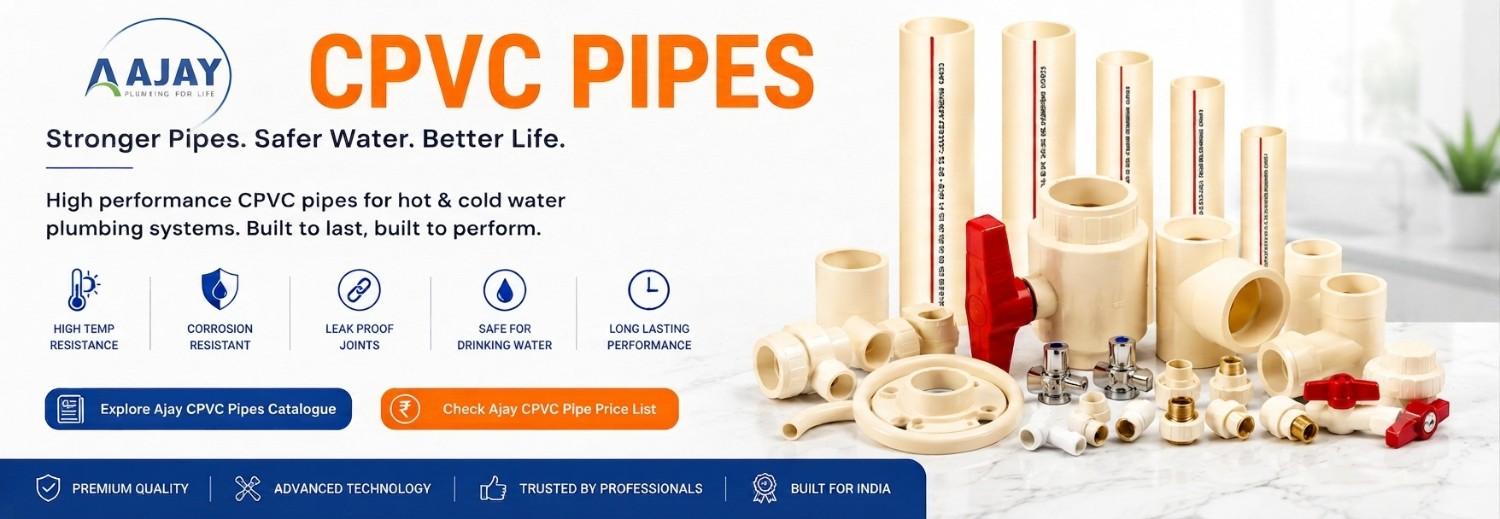
Ajay sells solvent cement through its network of dealers and distributors. Pack prices vary by size and order quantity, so ask your local dealer for a current quote. For a complete system, pair the cement with Ajay Flowline Plus CPVC pipes and fittings. You can also check item codes in the Ajay catalogue.
FAQs
It joins CPVC pipes and fittings by softening the mating surfaces so they fuse into a leak-resistant weld. Plumbers use it in residential, commercial, and industrial hot and cold water systems.
For common sizes up to 2 inches, a one-step CPVC cement such as Ajay Flowline Plus cement works without primer. For sizes above 2 inches, Ajay recommends purple primer with heavy duty gray cement.
Under normal conditions, allow 24 hours before pressure testing. Cold weather, high humidity, larger pipe sizes, and higher test pressure all need more time, so check the curing table above.
No. Ajay advises against using fusion compounds made for PVC or other plastics on CPVC pipes and fittings. Always use a cement made for CPVC.
A 473 ml can makes about 328 joints on 1/2 inch pipe and about 68 joints on 2 inch pipe. Larger pipe uses more cement per joint, so the count drops as size rises.
For any queries, contact the plumbing experts at Ajay pipes on the Toll Free No. : 1800-11-4050 or via email at our email address info@ajaypipes.com